
Getting Started with Integrated Pest Management
Integrated Pest Management (IPM) gives farmers a robust, sustainable and evidence-based framework for managing pests while reducing chemical inputs and enhancing biodiversity. With the upcoming Sustainable Farming Incentive (SFI) offer in 2026, practical tools and free advice available through your local Catchment Sensitive Farming team, getting started or building on the IPM practices you already use has never been easier.
Whether you farm cereals, horticulture, livestock or mixed enterprises, adopting IPM is an investment in long term resilience and productivity.
As expectations grow to reduce reliance on chemical pesticides while protecting yields and biodiversity, IPM offers a structured and science-based approach to managing pests, weeds and diseases and is suitable for all farmers, growers and land managers.
What Is Integrated Pest Management?
The UK Government defines IPM as a whole farm approach using a combination of techniques to support healthy crops, enhance biodiversity, manage pesticide resistance, and reduce dependency on chemical plant protection products (PPPs).
The aims of an IPM approach are to:
- support healthy crops using a range of plant protection methods
- support resilient and sustainable agricultural production
- help manage pesticide resistance
- encourage natural control mechanisms
- enhance wildlife and biodiversity
- reduce reliance on the use of chemical pesticides, also known as plant protection products (PPPs)
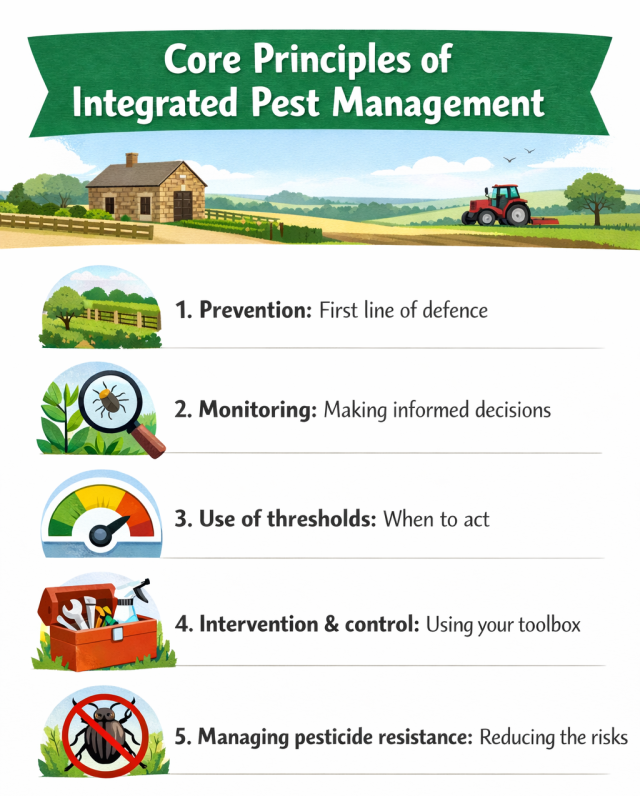
Core Principles of IPM
1. Prevention: First line of defence
You can use preventative methods to reduce the risk of pests, weeds and diseases becoming established. This can include:
- crop rotation
- encouraging natural predators
- cultivation and tillage practices (how the land is prepared to grow crops)
- growing pest and disease-resistant varieties
- hygiene measures (for example, regular cleansing of machinery and equipment)
- using trap crops to draw away pests

2. Monitoring: Making informed decisions

Animals and plants classified as pests or weeds may be important to the structure and function of local ecosystems. Effective monitoring ensures you only use chemical pesticides when necessary. You should choose the correct control method for your land and apply it at the right time. This can include:
- inspection of crops
- pest, weed and disease identification
- forecasting and assessing levels of pest populations and diseases
- the use of early diagnosis systems, decision support systems and advice from professionally qualified individuals, advisers or agronomists
3. Use of thresholds: When to act
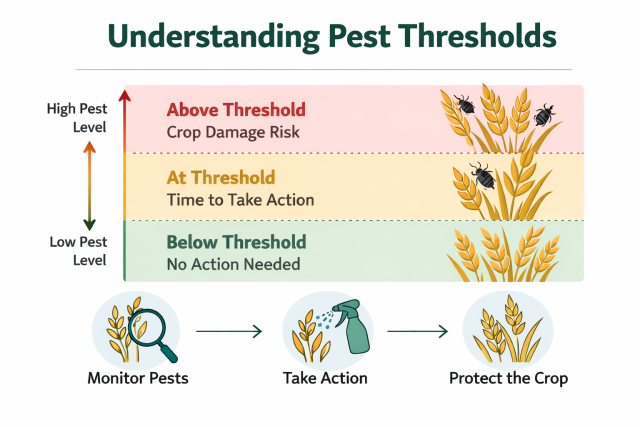
You can use thresholds which take into account pest, weed and disease pressures, region, crops and climatic conditions to help you decide when to use control measures.
Once a threshold, or predicted threshold, has been exceeded (such as when pest population levels, pest damage or weed prevalence become economically or environmentally unsustainable) you should take action to control the pest.
4. Intervention and control:
Using your toolbox

The control methods you choose should be practical and effective. You can use sustainable physical, biological and chemical methods.
Physical control measures can include:
- mechanical weeding and hand weeding
- physical barriers such as netting and mulching
Biological control measures can include:
- predatory species
- biopesticides, such as using microbes or pheromones to disrupt insect mating
If you use chemical pesticides, you should use:
- the minimum effective dose and application frequency
- targeted application to minimise potential negative impacts – for example, using precision technology like spot treatments and weed wipers
5. Managing pesticide resistance: Reducing the risks
The overuse of chemical pesticides can lead to resistant pests, weeds and diseases. You can use anti-resistance strategies to maintain the effectiveness of chemical pesticides. This can include using:
- the appropriate dosage rates of pesticides
- pesticides with multiple modes of action
These strategies should be used when:
- the risk of resistance against a plant protection measure is known
- the level of harmful organisms requires repeated application of pesticides to the crops
Review and evaluation: What’s working for me?
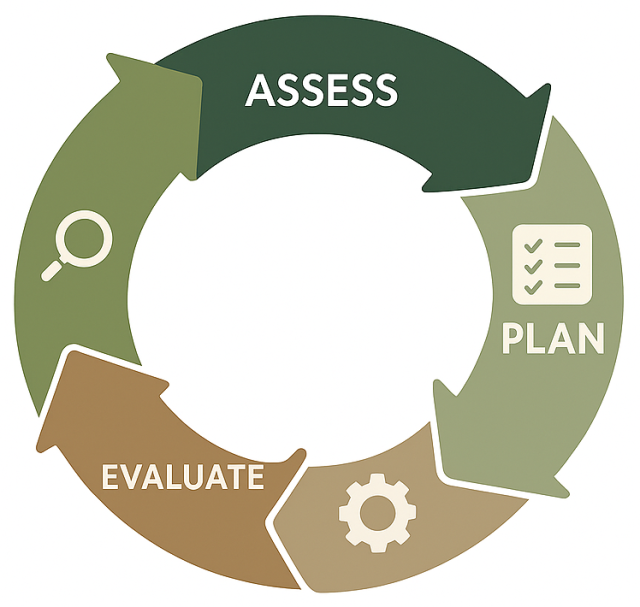
IPM is not a fixed set of practices but a flexible approach that requires continuous evaluation. It is about attentive farming practices and land management - using skills and knowledge to overcome challenges and take decisions that are right for each farm.
Review the success of all plant protection and control measures regularly to ensure their effectiveness and make better-informed decisions for future seasons. This can be done by creating an IPM plan which you should review every year.
If you use pesticides professionally
If you use pesticides in a professional capacity, you must be registered with Defra. All users of professional pesticides must hold an accredited certificate (unless you are working under the direct supervision of someone who holds one).
Distributors, advisors and professional users of pesticides have access to training by bodies approved by the regulator. Find the list of UK designated bodies and recognised specified certificates here.
Useful Tools and Support
Creating an IPM Plan
An IPM plan can you:
- apply different control measures to your crops
- minimise the risks associated with the use of chemical pesticides
It should describe how you plan to apply IPM to your land. It can include details of:
- your land and the crops you grow
- the pests, weeds and diseases you have identified or consider to be a risk on your land
- control measures in the current season and plans for next season
You can find IPM plan templates online and you should decide which works best for you.
IPM plan templates that contain written guidance for certain crop types are available. This is optional.
Assess your IPM approach using decision support systems (DSS)
Decision support systems can help you manage and respond to different pest, weed and disease pressures to your crops.
Decision support systems include tools for:
- monitoring and treatment thresholds
- forecasting pest density and damage
- comparing treatments
You can find decision support systems for many pests, weeds and diseases online and you should decide which works best for you.
IPM Decisions may help you assess which decision support systems are relevant to your land. This is optional.
Sustainable Farming Incentive (SFI)
This recent Defra Farming blog post outlines what to expect from the new SFI 2026 offer – please see this page for more details about you can be paid to complete IPM actions.
The table below provides a summary:
| Action code | SFI action | Annual payment |
| CIPM2 | Flower-rich grass margins, blocks or in-field strips | £798/ha |
| CIPM3 | Companion crop on arable and horticultural land | £55/ha |
| CIPM4 | No use of insecticide on arable crops and permanent crops | £45/ha |
Hear from other farmers about how they use IPM:
Video Series:
Integrated Pest Management focusing on disease control in cereals – a science-based approach
In collaboration with ADAS, Defra have created 14 videos that bring to life the science behind IPM and showcase best practice for managing diseases in cereals.
The videos focus on:
- crop production and plant disease epidemics
- disease control methods
- managing fungicide resistance
- environmental considerations
The videos can be viewed in any order that interests you, but they'll make most logical sense viewed in the order in the menu.
You can find them on the ADAS YouTube channel.
Watch
Jonathan Boaz, a farmer from Worcestershire who has won award for his soil management approach, shares how he has been using IPM preventative measures for several years and what inspired him to start.
Listen
This Defra Farming Podcast Episode features arable farmer and leader of the British On Farm Innovation Network (BOFIN), Tom Allen-Stevens, speaking with farmer Martin Lines and agronomist Ed Schofield about their experience of implementing IPM.
Read
Small gains, big wins
David Bell, a farmer and Voluntary Initiative (VI) Champion and new UK Chair of the VI, from Upper Magus Farm in East Fife, shares his approach to IPM.
"I have a mixed farm here in East Central Scotland where I have a beef suckler herd with arable and potato enterprises.
Prevention is always more effective than cure and maintaining a varied rotation is key to reducing the need for Plant Protection Products (PPPs) while supporting soil health.
A cornerstone for many is the AHDB Recommended Lists, where I select the best agronomic variety highlighted by disease ratings to suit my ground and market.
I prepare my fields ready for crop establishment by using a full spectrum of techniques depending on their capability. This includes full inversion deep ploughing through to direct drilling, into 4-foot-tall standing cover crops.
Working with my BASIS-trained agronomist, we assess weed, disease and pest pressures and look at tolerances and thresholds before we apply PPPs to crops.
Maintaining my sprayer correctly and having an annual National Sprayer Testing Scheme assessment as well as my own continual updates through the National Register of Sprayer Operators, ensures that my pesticides go in the right place. This means I retain the full value and effectiveness of the product on the crop.
There is no silver bullet for farming, and IPM is no different. We focus on incremental gains that add up to big wins over time."
Using IPM on a mixed farm
Emma Hamer, a Farmer and Voluntary Initiative (VI) champion, from Meadowsweet farm in Oxfordshire shares her approach:
“My husband and I have a small beef and arable farm on the Oxfordshire – Warwickshire border. We are both BASIS qualified and NRoSO registered and keep up to speed on IPM research through continuing professional development (CPD).
We do all we can to maximise crop pest predator numbers or ‘beneficial insects’ through creation and maintenance of habitats where they thrive. We practice regenerative agriculture, establish crops with a direct drill, grow cover crops, have wide margins and hedges around most fields which also provide a refuge for these beneficials.
Having a beef herd allows us to have a wide rotation. When there is a black grass problem in a field, we can put it down to grass or grow a herbal ley or grazeable cover crop to try to reduce the weed pressure. Similarly, when weed burdens become a problem, possibly through herbicide resistance, we have the option to bury weed seeds and create a clean seed bed.
Our philosophy with pesticides is to use as little as possible, and only as much as is necessary. By walking crops regularly, and working with our agronomist, we usually manage this and haven’t used an insecticide for many years – but sometimes the use of an appropriate intervention in the form of a pesticide is crucial to our integrated approach to pest, weed and disease management.”
Using IPM to improve soil health
David Blacker from Shipton, North Yorkshire shares how he uses IPM approaches to farm combinable crops.
"Soil health is the biggest challenge on-farm and I’m particularly interested in improving it whilst increasing economic yields.
I’ve been trialling different approaches to do this over the years and as AHDB Strategic Cereal Farm North, we've been working with ADAS to design several trials. These look at improving drainage, increasing soil health, the number of worms and adjusting nitrogen and nutrient inputs in response to frequent crop monitoring.
To me, integrated pest management is just good farming practice. I take measures on farm to increase biodiversity, including having wide margins on most fields and planting pollinator strips as part of the countryside stewardship scheme.
These areas provide food sources for pollinators and support natural pest predators. Pesticides are minimally used on farm and you can see the benefits of this in the number of spiders and ladybirds, for example.
Recently, we’ve been looking at a clover understory in winter wheat to improve soil health, suppress weeds and increase nitrogen use efficiency. We’re also often trialling new technology. We are currently using soil micronutrient sensors to improve the timing of nitrogen and nutrient applications."
An agronomist's view
Sean Sparling, a multi-award-winning independent agronomist shares his views on what makes IPM successful.
"IPM is nothing new. Every farm employs certain IPM techniques such as rotations, variety choices, cultivation strategies, methods to encourage and increase beneficial insects and the targeted use of pesticides when necessary.
An IPM approach should not be considered as one specific action. Rather, it is a mindset and an attitude towards every decision taken, with its roots firmly anchored in good agricultural practice.
Fundamental to the success of IPM is having a dedicated mindset of the principles of IPM which will help you reach its full potential and its aims. Keeping an open mind, utilising an IPM plan and decision-making tools, as well as developing a working knowledge of IPM by putting it into practice is key.
So, embracing that IPM is a mindset, not a single action that can be deployed independently, using trial and improvement on your strategy as you go and working with an agronomist who shares your mindset can help you on your IPM journey."
External IPM guidance
The following organisations offer free guidance and information (this list may not be exhaustive).
ADAS conducts research and provides guidance
Agriculture and Horticulture Development Board’s (AHDB) IPM hub provides IPM tools and guidance for farmers
IPM@Hutton conducts research and provides IPM resources
IPM Works is a network demonstrating and promoting IPM strategies
Voluntary Initiative is an industry led scheme which provides IPM planning tools, infographics and guidance for farmers
Please be aware; AI has been used in the generation of infographics in this article